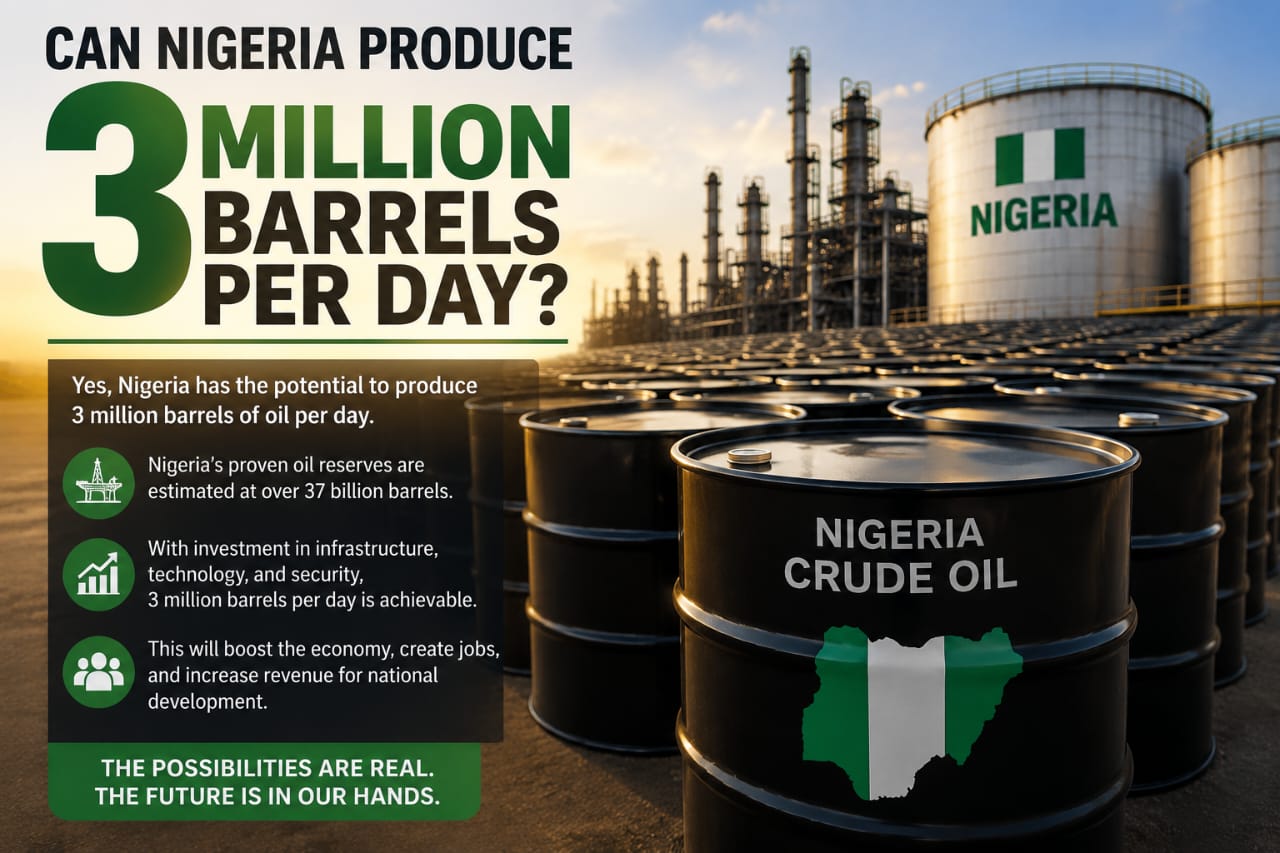
My discussion on BusinessDay TV reaffirmed a fundamental petroleum economics reality: Nigeria’s challenge is not the availability of petroleum resources, but the certainty of policy, the credibility of institutions, and the effectiveness of execution.
The aspiration to produce 3 million barrels of oil per day (MMBOPD) by 2030 remains technically achievable, but it is becoming increasingly challenging. The reason is straightforward. Nigeria’s existing producing assets are mature and, based on industry estimates, experience an average annual production decline of approximately 15%, equivalent to nearly 300,000 barrels per day each year. This means that the country must first replace declining production before adding new productive capacity.
Consequently, achieving 3 MMBOPD is not simply a matter of increasing production by one million barrels per day. It requires replacing natural declines while simultaneously bringing on significant new developments. Industry estimates indicate that this would require developing the equivalent of 4–5 billion barrels of recoverable reserves, supported by approximately US$50–70 billion in new investments over the next few years, together with timely Final Investment Decisions (FIDs), efficient project execution, and a stable investment climate.
A key message I emphasized is that policy certainty is the foundation of investment certainty. Investors commit long-term capital only when fiscal and regulatory frameworks are predictable, transparent, and consistently applied. The Petroleum Industry Act (PIA) provides an important framework, but legislation alone does not produce oil. Success depends on consistent implementation, regulatory credibility, security of operations, and commercial discipline.
Equally important, Nigeria requires institutions led with an application-oriented leadership mindset—one that places greater emphasis on execution than aspiration, implementation than proclamation, and accountability than rhetoric. Strong institutions inspire investor confidence, while credible leadership transforms policy into measurable economic outcomes.
Based on current investment trends and the pace of project sanctions, a production level of about 2.5 million barrels per day by 2030 appears to be the more realistic outcome, unless Nigeria witnesses a significant acceleration in capital investment, project delivery, and production optimization over the next few years.
Ultimately, barrels are produced through investment and execution—not by ambition alone. Nigeria’s petroleum resources are abundant; the real challenge is converting policy certainty into investor confidence, investor confidence into capital investment, and capital investment into sustainable production. The pathway to 3 MMBOPD is paved not by licence awards, but by investment, execution, and institutional leadership.
Wumi Iledare
Professor Emeritus of Petroleum Economics